
Insights
🔍 Overview
Educators from different school levels in Singapore shared how they integrate AI tools like ChatGPT and educational chatbots into their teaching practice. Their focus is on enhancing cognitive development, autonomous learning, critical thinking, and ethical AI use—particularly in language, science, math, social studies, and oral communication.
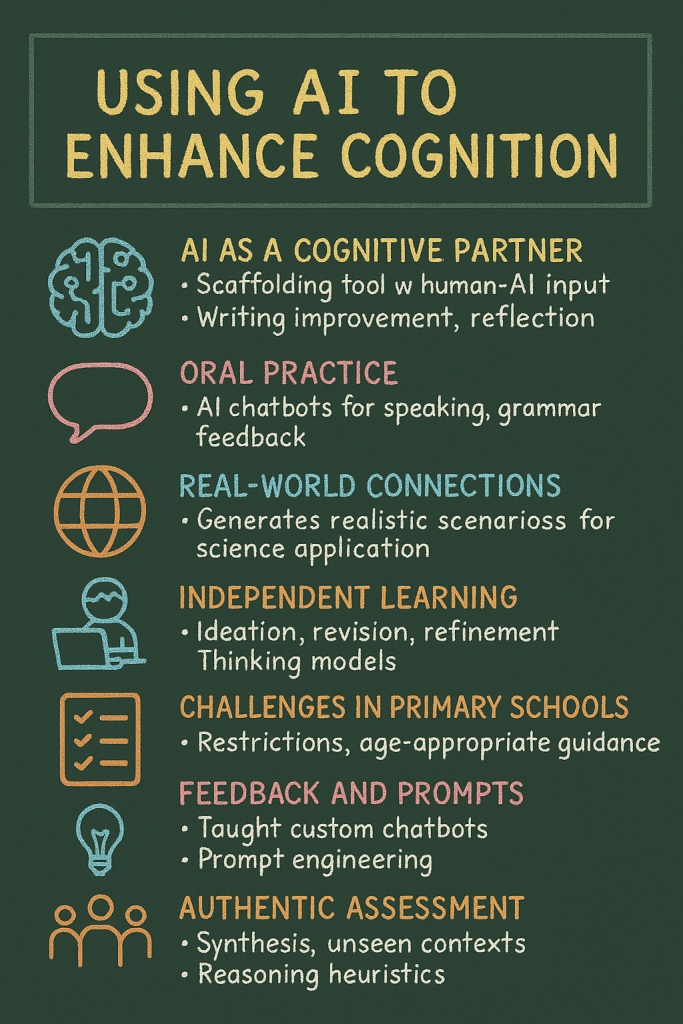
🧠 1. AI as a Cognitive Partner, Not Just a Tool
- AI is seen not just as a shortcut or answer provider, but as a scaffolding tool that encourages thinking and iteration.
- Teachers emphasized the importance of students creating first drafts before using AI for feedback.
- Combining human and AI input (e.g., “combo writing”) is used to strengthen writing skills and reflection.
🗣️ 2. AI for Oral Practice and Expression
- Schools are deploying AI chatbots for oral communication training, especially in English and Chinese.
- Students respond to oral prompts and ask AI for feedback to improve grammar and expression.
- Customized chatbots simulate dialogues and interviews, including with historical figures or fictional characters, to build confidence and contextual understanding.
🔬 3. Enhancing Real-World Connections
- Science teachers use AI to generate realistic scenarios so students can apply concepts to everyday life.
- Helps bridge the gap between theory and application, a common challenge in science education.
🎯 4. Supporting Independent Learning
- Students use AI to:
- Spark ideas for unfamiliar topics.
- Revise content and refine understanding before seeking teacher feedback.
- Seek feedback and make iterative improvements on their own.
- Educators noted the importance of thinking models to guide interaction with AI, preventing over-reliance.
⚠️ 5. Challenges in Primary Schools and Guardrails
- Primary school teachers face restrictions from the Ministry in AI use, which limits experimentation.
- There is a need for clear guidance and tools that are age-appropriate and comply with existing frameworks.
- Concerns include:
- Students replicating errors in AI responses (“rubbish in, rubbish out”).
- Overuse of AI by parents to complete student work, bypassing the learning process.
- Inconsistent feedback from AI platforms, especially in non-text responses like math drawings.
🔄 6. Feedback, Prompting, and Ringfencing
- Prompt engineering and custom AI chatbots were emphasized:
- Chatbots were programmed to act as tutors, guiding students with Socratic questions rather than answers.
- Teachers upload notes and prompts to “ringfence” content and control the AI’s scope and depth.
- Custom bots ensure alignment with learning outcomes and provide structured interaction.
🧭 7. Teaching Good Questions & Critical Thinking
- A major focus is on teaching students to ask quality questions to get better AI responses.
- Lessons emphasize:
- Formulating clear, structured prompts.
- Evaluating the accuracy and reliability of AI-generated answers.
- Encouraging reflection over passive reception.
🧪 8. Authentic Assessments and the Illusion of Understanding
- Concern over students mistaking having answers for understanding concepts.
- To counter this, assessments should involve:
- Unseen contexts or questions to ensure application, not memorization.
- Projects that require synthesis and originality, e.g., “My Grandfather’s Road” or interviewing historical figures via AI.
🧩 9. Philosophical and Logical Thinking Skills
- A key takeaway: Singapore education should include logic, philosophy, and reasoning heuristics.
- Students often memorize rather than internalize or explain causality.
- Teachers suggest simple logical frameworks (e.g., “If X, then Y”) and philosophical inquiry to deepen reasoning.
🛠️ 10. Professional Development & Sharing Resources
- Schools are conducting PD sessions for teachers on prompt engineering and AI customization.
- Resources are shared among educators, including:
- Guides to customize chatbots.
- Prompts for age-appropriate tutoring.
- Creation of WhatsApp groups for collaborative learning and sharing AI strategies.
🎓 Final Reflections
- The intentionality behind AI use is crucial: not to replace thinking but to enhance it.
- Educators must lead the way in modeling process-based learning and responsible AI use, especially since many parents focus on outcomes.
- With proper ringfencing, prompt design, and cognitive focus, AI can become a transformative force for deep, critical learning.