
Insights
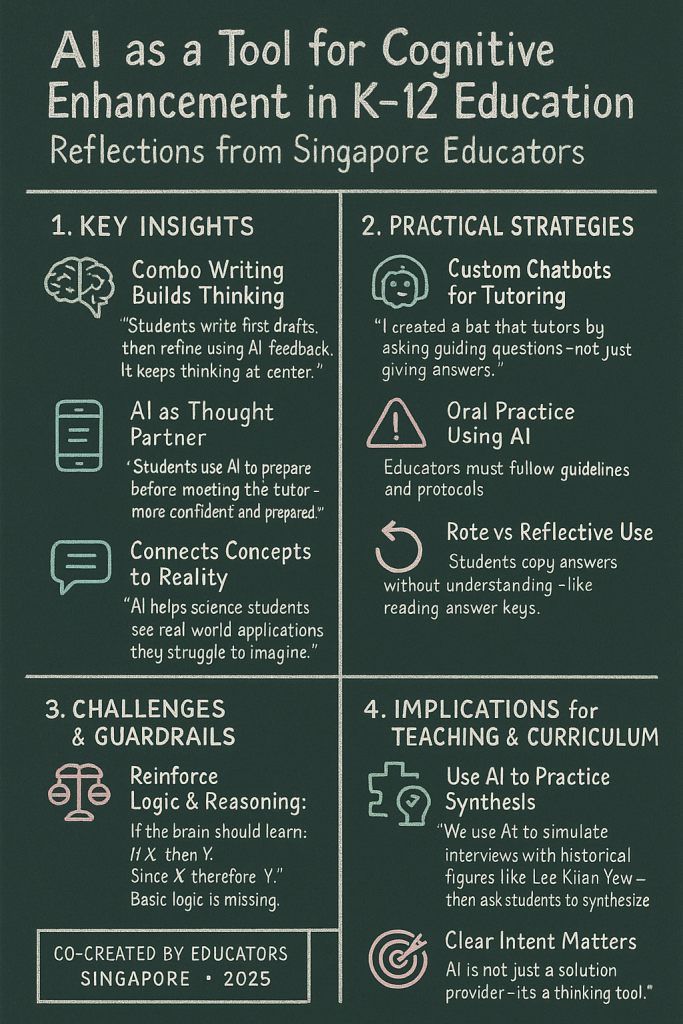
🧠 1. Purposeful Use of AI for Learning Enhancement
- Combo Writing Strategy: Students first draft essays, then use AI for targeted feedback and refinement, ensuring they think before relying on AI assistance.
- Scaffolded Feedback: Teachers guide students in prompting AI to generate useful, focused feedback, rather than generic help.
- Oral Practice via AI Chatbots: AI is used for practicing oral communication, grammar correction, and refining expression in a more natural, low-stakes environment.
- Authentic Scenarios Generation: Science teachers use AI to generate real-life application scenarios to help students connect abstract concepts to the real world.
🔍 2. Independent and Reflective Learning
- AI encourages autonomous ideation, revision, refinement, and self-directed feedback, allowing students to approach teachers better prepared.
- Schools emphasize the importance of pairing AI use with thinking models to promote responsible and critical interaction with AI-generated content.
- Teachers expressed concern about “passive consumption”—students skimming AI output without processing it, which limits actual learning.
⚖️ 3. Cognitive Science and Developmental Considerations
- At the primary level, educators are cautious due to neuroscientific concerns—early learners need to actively construct neural connections rather than rely on AI shortcuts.
- The worry is that if students don’t engage with material meaningfully (e.g., use AI-generated answers passively), it becomes “white noise”, leading to surface learning.
🛠️ 4. Prompt Engineering and Chatbot Customization
- Some educators are already creating custom chatbots using tools like ChatGPT:
- Chatbots serve as interactive tutors rather than answer providers.
- Prompts are crafted to simulate tutoring behavior, asking guiding questions.
- Teachers shared experiences building subject-specific bots (e.g., for Chinese oral exams), setting ringfenced parameters to control content and language level.
🧭 5. Ethical Use and Guardrails
- Teachers emphasized:
- Clear intent and purpose for AI use in the classroom.
- Avoiding “AI as shortcut”; instead, teaching metacognitive awareness.
- The importance of educating students to ask good questions and critically evaluate AI answers.
- Concern raised that if left to parents or unregulated use, students may adopt an outcome-driven, task-completion-only mindset, missing deeper learning.
📚 6. Curriculum and Assessment Design
- Some schools align AI use with existing frameworks like EOT (Elements of Thought).
- There’s a call to reinforce logical reasoning and philosophy in curricula:
- Teach students to reason: “If X, then Y” (basic logical inference).
- Encourage critical thinking over rote memorization of AI-generated explanations.
- Teachers see value in assessments with unseen questions and contexts to encourage students to apply reasoning, not recall answers.
🧩 7. Practical Challenges
- Primary schools face MOE restrictions and cautious implementation guidelines.
- Reliability issues with some platforms (e.g., QReport in Math)—inconsistent or incorrect AI feedback remains a problem.
- Teachers expressed difficulty in ensuring learning outcomes are not diluted when customizing lessons with AI.
💬 8. Examples of Application
- Social Studies/History: Students interview simulated historical figures like Lee Kuan Yew to practice synthesis and presentation skills.
- Project-Based Learning: AI aids students in projects like “My Grandfather’s Road”, but educators stress guiding students to own their learning.
- Custom Chatbot in Lessons: Teachers uploaded notes and embedded guiding prompts to create chatbots that function as tutors, prompting deeper thinking.
📌 9. Professional Development and Collaboration
- Schools conduct staff PD sessions on prompt engineering and chatbot creation.
- There’s a growing culture of collaboration: sharing chatbot examples, creating WhatsApp groups, and using resource articles to build collective capability.
🧠 Final Reflection:
Educators recognize that AI is here to stay. The focus is shifting from blocking or restricting access to guiding students toward reflective, ethical, and effective usage. AI, when intentionally integrated, can:
- Promote critical thinking.
- Enhance self-directed learning.
- Foster higher-order cognitive engagement.
However, it also requires:
- Strong teacher training.
- Consistent guardrails.
- Emphasis on questioning, logic, and philosophical reasoning to prevent over-reliance and superficial learning.