A Day in the Life
Alex is fictional. The learning experiences are not predictions. They are one possible way of making participant ideas tangible: learning by doing, flexible environments, human relationships, expert teaching, learner agency and AI that supports without deciding.
Before reading the story,
see the day.
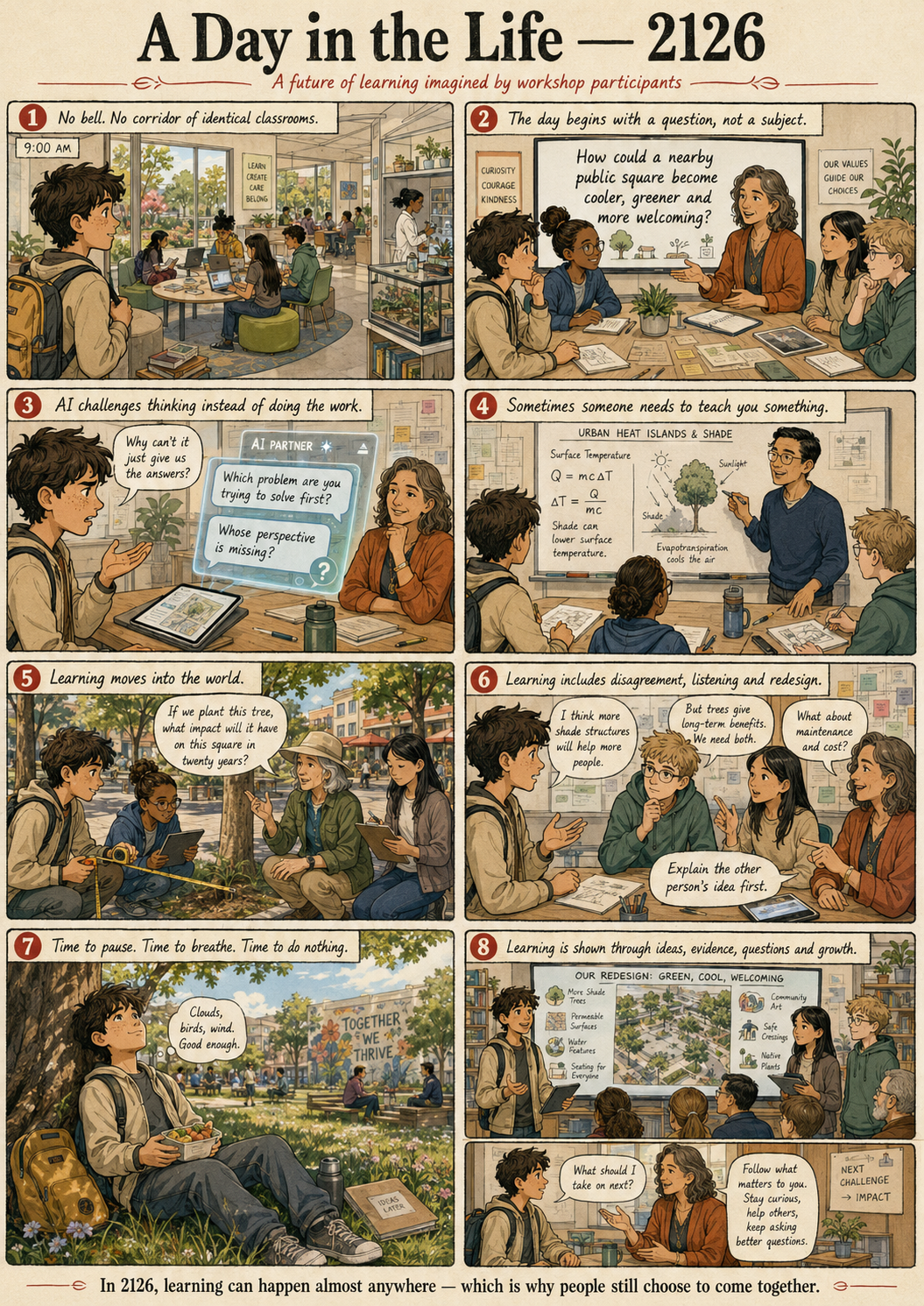
Learning imagined through workshop participant conversations.
Alex arrives a few minutes before nine.
There is no bell.
Nobody is rushing through a corridor toward rows of identical classrooms.
The learning hub is already alive.
School is still here.
A few people are sitting around large tables. Someone is reading in a quiet corner. Two learners are outside in the garden, and another group is carrying equipment toward the science space.
It still looks like a school.
Just not one organized around classrooms.
The day begins with a question.
“How could a nearby public square become cooler, greener and more welcoming to the different people who use it?”
Alex’s group gathers around a table with their educator. Their work will involve science, mathematics, design, communication — and probably things they have not identified yet.
“What do we need to understand before we start proposing solutions?” she asks.
Shade. Plants. Heat. Measurement. Cost. Materials. People.
The AI refuses to answer.
Alex opens the group’s AI system.
“Give me three possible designs for the square.”
“Which problem are you actually trying to solve first?”
“And whose perspective is missing from your description?”
Alex looks annoyed.
“That wasn’t my question.”
“I know,” says the system.
The educator smiles.
“Answer it anyway.”
Sometimes someone needs to teach you something.
Soon the group discovers that they can describe what they want to build but cannot properly explain why some surfaces become hotter than others.
Their calculations are not much better.
The educator stops them.
For twenty minutes, the project disappears.
She teaches.
She explains a scientific concept they need. Then she works through the mathematics required to compare two designs.
The learners draw, calculate, question and make mistakes.
Then the project returns.
Now they can see things they could not see before.
Learning moves into the world.
The group leaves the building.
At the square, they measure surfaces, map shade and watch where people actually sit.
A landscape specialist is waiting for them.
Alex proudly shows her where the team wants to plant a large tree.
“What happens underneath in ten years?”
Nobody answers.
“The roots,” someone eventually says.
An older person nearby tells them that the area they want to redesign has been a gathering place for decades.
Suddenly their problem is not only environmental.
It is historical. Social. Emotional.
The solution has become more difficult.
And much more interesting.
Nobody wins the argument.
Back at the hub, the group disagrees.
One learner wants the most environmentally ambitious design.
Another argues that it would destroy something valued by the people who already use the square.
Alex thinks they are both wasting time.
The educator refuses to settle the argument.
“Before defending your own position, explain the other person’s view well enough for them to say: ‘Yes. That’s what I mean.’”
It takes longer than expected.
Eventually they change the design.
Nobody has won.
The idea has simply become better.
Nothing happens.
For thirty minutes, Alex has no assigned task.
There is no “productive use of free time” requirement.
Alex could keep working. Could read. Could talk. Could go outside.
Today Alex eats lunch and lies beneath a tree.
For a while, nothing educational happens.
Or at least nothing anybody needs to measure.
AI helps them see what they missed.
The AI organizes the observations from the morning and identifies a weakness.
They spoke with plenty of adults but almost no younger children.
It offers three possible interpretations.
“Which one is right?” Alex asks.
“You have enough evidence to reject one.”
“You do not have enough evidence to choose between the other two.”
“What would you need to find out?”
The AI could probably generate a convincing answer.
That is not what they need from it.
They need it to help them see what they have missed.
Show us what you understand.
There is no ten-question test waiting for them.
But that does not mean nobody has to demonstrate anything.
Alex’s group has eight minutes.
They show their current design. They explain the measurements behind it. They describe what changed after meeting the specialist. They identify one disagreement they have not solved.
Then come the questions.
A peer challenges one assumption.
The specialist identifies a practical problem.
The educator asks Alex to explain the mathematics behind one design choice.
Halfway through, the explanation falters.
Alex tries again.
Better.
Not perfect.
That part goes onto tomorrow’s list.
Choice does not mean choosing only what is easy.
Alex meets the educator for ten minutes.
The AI has suggested three possible directions for the next stage of the project.
Alex immediately chooses one.
“Why that one?”
“Because I’m good at it.”
“Exactly.”
The educator points toward another option.
“This is the one you’re avoiding.”
Personalized learning, Alex has discovered, does not mean spending your life doing only what you already enjoy.
They make a deal.
Part of next week’s work will follow Alex’s strongest interest. Part will deliberately go somewhere more difficult.
The decision belongs to Alex.
But it is not made alone.
Learning hasn’t finished.
Some learners stay. Others leave.
Alex has sport later in the afternoon and enough time before it begins to go home, eat something and do absolutely nothing for a while.
Tomorrow’s work may begin at home.
Or in the garden.
Or with a specialist.
Or somewhere in the city.
But Alex will return to the hub.
Alex returns because the people are there.
The educator who knows when to explain and when not to. The friend who sees the problem differently. The person Alex would never have chosen to work with. The specialist who asks the question nobody considered. The community whose lives make the project real.
That may be precisely why there is still somewhere people choose to come together.