
Insights
🔍 1. Reframing the Role of the Teacher
- From knowledge provider to cognitive coach: With AI giving students direct access to information, the teacher’s role shifts toward developing 21st-century competencies like critical thinking, communication, collaboration, and discernment.
- Facilitators of inquiry: Teachers should help students use AI not just to get answers, but to ask better questions, critique outputs, and engage in metacognitive processes.
🧠 2. AI as a Cognitive Enhancer
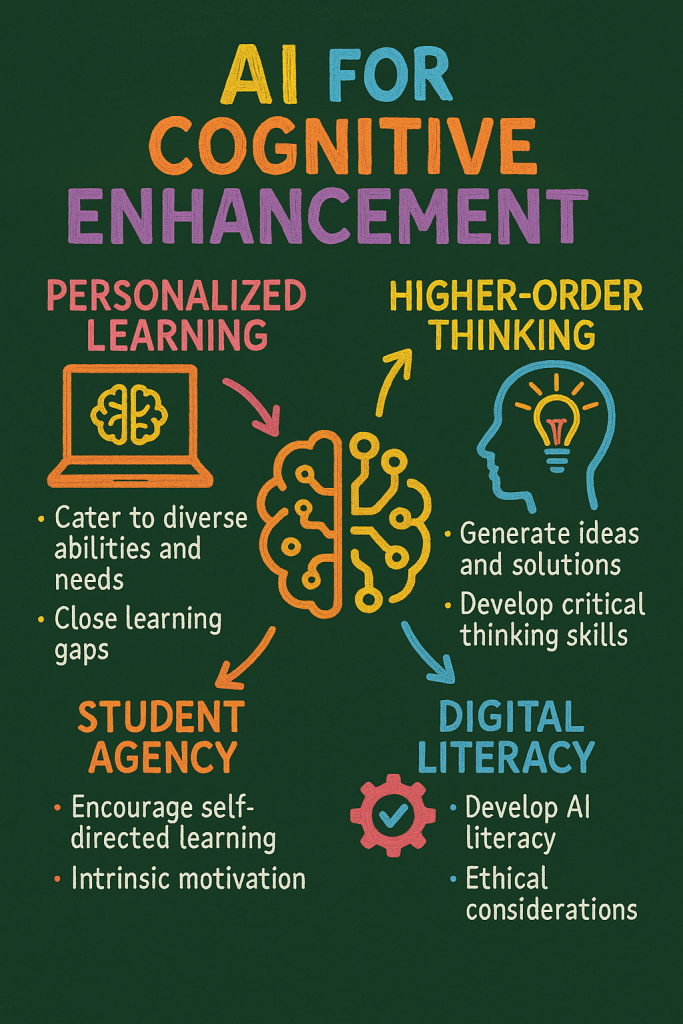
- Personalized Tutoring: AI can act as a personalized tutor, guiding students through step-by-step problem solving, especially in subjects like math and literacy.
- Adaptive Learning: Platforms like SLS (Student Learning Space) already embed AI to offer real-time feedback and differentiated learning paths.
- Prompt-Based Learning: Crafting prompts becomes an intellectual task—students must understand content deeply to prompt effectively, developing higher-order thinking.
⚠️ 3. Risks of Cognitive Inhibition
- Cognitive prosthetics concern: Some principals warned that over-reliance on AI might act as a “cognitive prosthetic,” bypassing necessary cognitive struggle and neural development.
- Shortcuts vs. Struggle: Students averse to cognitive effort may use AI to skip the learning process unless guided to reflect and revise.
🧩 4. Foundations First, Then AI
- The need for strong foundational skills: Especially at the primary level, students must first develop core skills in literacy, numeracy, and reasoning before effectively benefiting from AI tools.
- Progressive use: AI is more effective for students who already possess basic competencies and motivation.
🛠️ 5. Prompt Engineering & Teacher Training
- Teachers need upskilling: There’s a consensus that teachers themselves need training in prompt engineering and AI pedagogies.
- AI pedagogy as a new field: A shared concern is the lack of clear frameworks to guide educators in effectively integrating AI into lesson design.
🧑🎓 6. Student Agency & Digital Literacy
- Discernment is critical: Students must be taught to question AI outputs, identify bias, and validate sources. This forms part of broader digital literacy and ethical AI use.
- At-home usage challenge: While AI can be used effectively in class, its use at home is unregulated, raising concerns about unchecked AI-generated work that mimics human errors to avoid detection.
📊 7. Assessment & Academic Integrity
- Difficulty detecting AI-written work: Teachers report challenges in differentiating genuine student work from AI-generated content, especially for take-home assignments like essays or orals.
- Call for assessment redesign: There is a push to shift assessments toward formats that encourage authentic thinking (e.g., oral interviews, real-time critiques).
🧪 8. Examples of AI-Enhanced Learning
- Music and Languages: In primary schools, AI was used for songwriting and pronunciation modeling (e.g., simulating ethnic accents in social studies), sparking engagement.
- CCE Discussions: AI tools like ChatGPT and Gemini were used in Character and Citizenship Education (CCE) to simulate moral reasoning and legal vs. ethical debates (e.g., on vaping).
🔮 9. Predictive Analytics for Social Concerns
- Preventive applications: AI can help identify at-risk youth (e.g., in the context of vaping) and generate age-appropriate interventions, educational content, or parental alerts.
- Scenario simulation: Principals explored AI’s potential to model long-term health or social impacts of risky behaviors using predictive analytics, fostering deeper student reflection.
📌 10. Conclusions and Next Steps
- AI can be both enhancer and inhibitor: Its value depends on context, intention, and pedagogy.
- Teachers must lead: Cognitive enhancement through AI only happens when teachers intentionally design tasks that foster thinking rather than answer-seeking.
- Ethical and safe use: Singapore’s digital policy frameworks (e.g., use of MOE platforms like SLS) provide a safe starting point, but broader digital discernment is essential.
Highlights
🧠 On the Role of AI in Learning vs. Knowing
“AI should not be about helping the students find answers. AI should be about helping the student learn.”
→ This reframes AI as a tool for process, not product, emphasizing its value in deep learning over shortcutting.
“We need to force the kids to actually go through the thinking process. And only after they’ve come up with their own solutions, then we kind of use AI to test or critique that.”
→ A thoughtful stance on sequencing AI use after cognitive struggle, preserving learning integrity.
🧠 On the Risk of AI as a “Cognitive Prosthetic”
“Suddenly, the idea of AI helping learning… doesn’t sound such a good thing anymore. What if we are actually inhibiting them from forming those neural networks?”
→ This shows awareness of neurocognitive implications, recognizing that premature AI intervention may hinder cognitive development.
🛠️ On Prompt Engineering and Metacognition
“Without the basic skill sets… they are unable to write a good prompt. Then, the product that comes out looks standardized, because they are not thinking critically.”
→ Insightful connection between language proficiency, metacognition, and AI fluency.
“I’m just wondering if teachers know how to write good prompts.”
→ A candid but crucial observation that points to the training gap among educators, not just students.
🧑🏫 On the Shifting Role of Teachers
“We are probably in the era whereby the teachers and students will learn alongside… but how can we make one step forward and be ahead of them?”
→ Recognizes the need for agile professional development and teacher leadership in the AI age.
“It’s not about technology, but pedagogy before technology.”
→ A powerful principle that insists on grounding all AI integration in sound educational design.
🧪 On Practical Use and Engagement
“In music and social studies, I used AI to let students hear how to say ‘Good morning’ in different languages, with accents. The kids were wowed.”
→ Highlights how multimodal, culturally relevant AI applications can spark engagement in non-core subjects.
🧩 On Equity and Access
“Not every student has someone at home to help. If AI can guide them step by step… then that’s where real enhancement happens.”
→ A nuanced understanding of how AI can close support gaps, especially for underserved learners.
🧠 On Digital Discernment
“How do you teach kids not to accept what’s there at face value? That’s where the enhancement comes—from validating, not copying.”
→ Beautiful articulation of AI’s role in fostering critical digital literacy.
🔍 On Redesigning Assessment
“We gave an oral assignment and all the answers were the same—AI-generated. So how do we ask questions in a way that can’t be answered generically?”
→ Identifies the need for assessment reform to measure authentic, individual thought.