Future Secondary School — Program Snapshot
Post-AI learning organized into 4 neighborhoods (≈150 students) around a central commons with acoustic zoning, privacy-without-isolation, and embedded technology.
600 students
7,500–9,000 m²
2 levels
Loop 2.6–3.0 m
Interpreted Design Brief Post-AI Learning
Educational Model
- AI-augmented mentorship: AI supports studio work; mentors lead critique, reflection, ethics.
- Project-based learning: studios replace classrooms; interdisciplinary production + public critique.
- Multi-modal ecology: focus, tutorials, collaboration, exhibition coexist.
- AI personalization: private rooms for sensitive tutoring, review, contestability.
- Neighborhood scale: 600 students in 4 neighborhoods (~150 each).
- Human connection: commons + critique support discourse and community.
Spatial + Operational Principles
- Acoustic gradient: loud → medium → quiet with buffering layers.
- Embedded tech: power/data/sensors integrated into millwork + structural grid.
- Privacy without isolation: pods along visible circulation, acoustically buffered.
- Critique culture: critique rooms adjacent to studios.
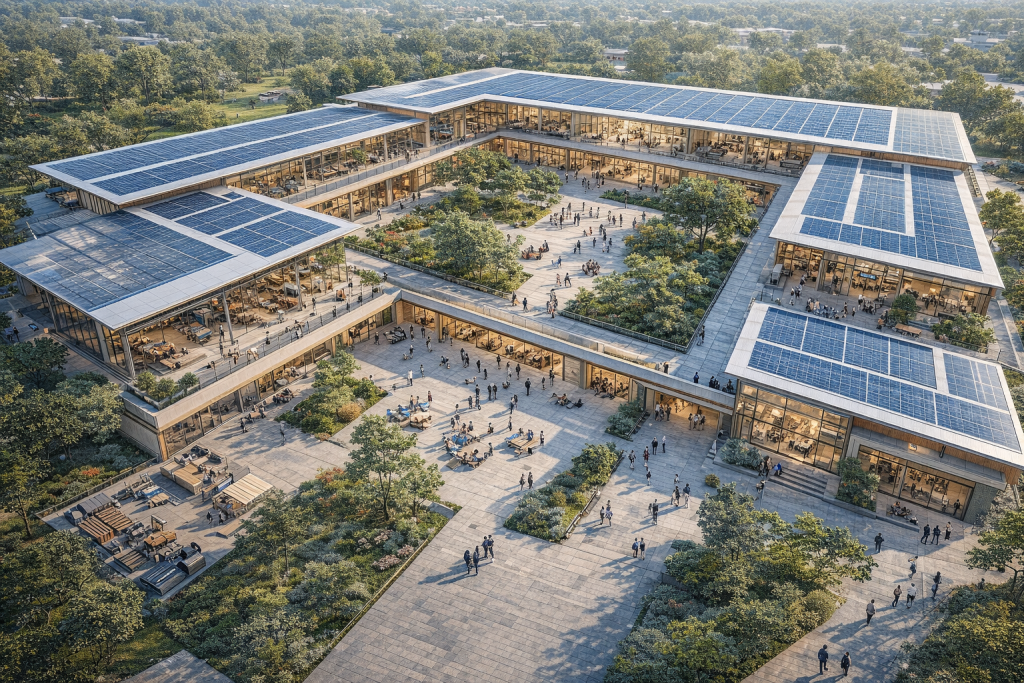
- Indoor–outdoor: makerspace + studios open to project yards.
- Safety + after-hours: supervision sightlines; public zones separated from secure ring.
- Buildability: modular grid (8–9 m bays) supports flexible partitions.
Program & Adjacency Areas + Rules
| Zone | Area Range |
|---|---|
| Learning Commons | 300–400 m² |
| Project Studios (8–10) | 70–100 m² each |
| Critique Rooms (4–5) | 35–55 m² |
| Makerspace | 150–180 m² |
| Breakout Rooms (16–20) | 12–18 m² |
| Micro-tutorial Rooms (12–16) | 8–12 m² |
| Focus Pods (40–60) | 4–6 m² |
| Calm Rooms (4–6) | 8–12 m² |
| Privacy / AI Rooms (8–10) | 6–10 m² |
| Support Suite | 80–120 m² |
| Storage + Tool Rooms | 60–100 m² |
| Circulation / Social Spine | ~25–30% floor area |
Neighborhood Kit (×4)
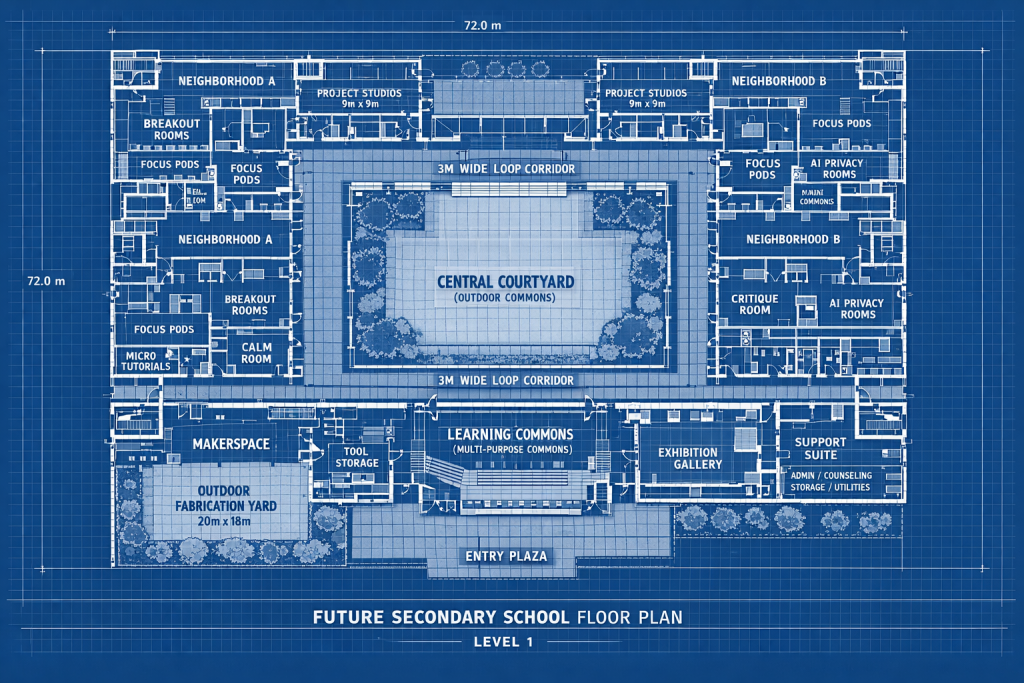
2 studios • 1 critique • 4 breakouts • 3 micro-tutorials • 10–14 focus pods • 1 calm room • charging wall • mentor station • mini-commons (80–100 m²)
Loop + Cluster Circulation
Main learning loop wraps the central commons; neighborhoods branch as cluster courts. Outdoor project yard connects makerspace + commons.
Loud Zone
makerspace / yard / tool store / commons edge
Medium Zone
studios / critique / breakouts / tutorials
Quiet Zone
pods / calm / AI privacy
Buffers: storage walls • acoustic vestibules • plant walls.