

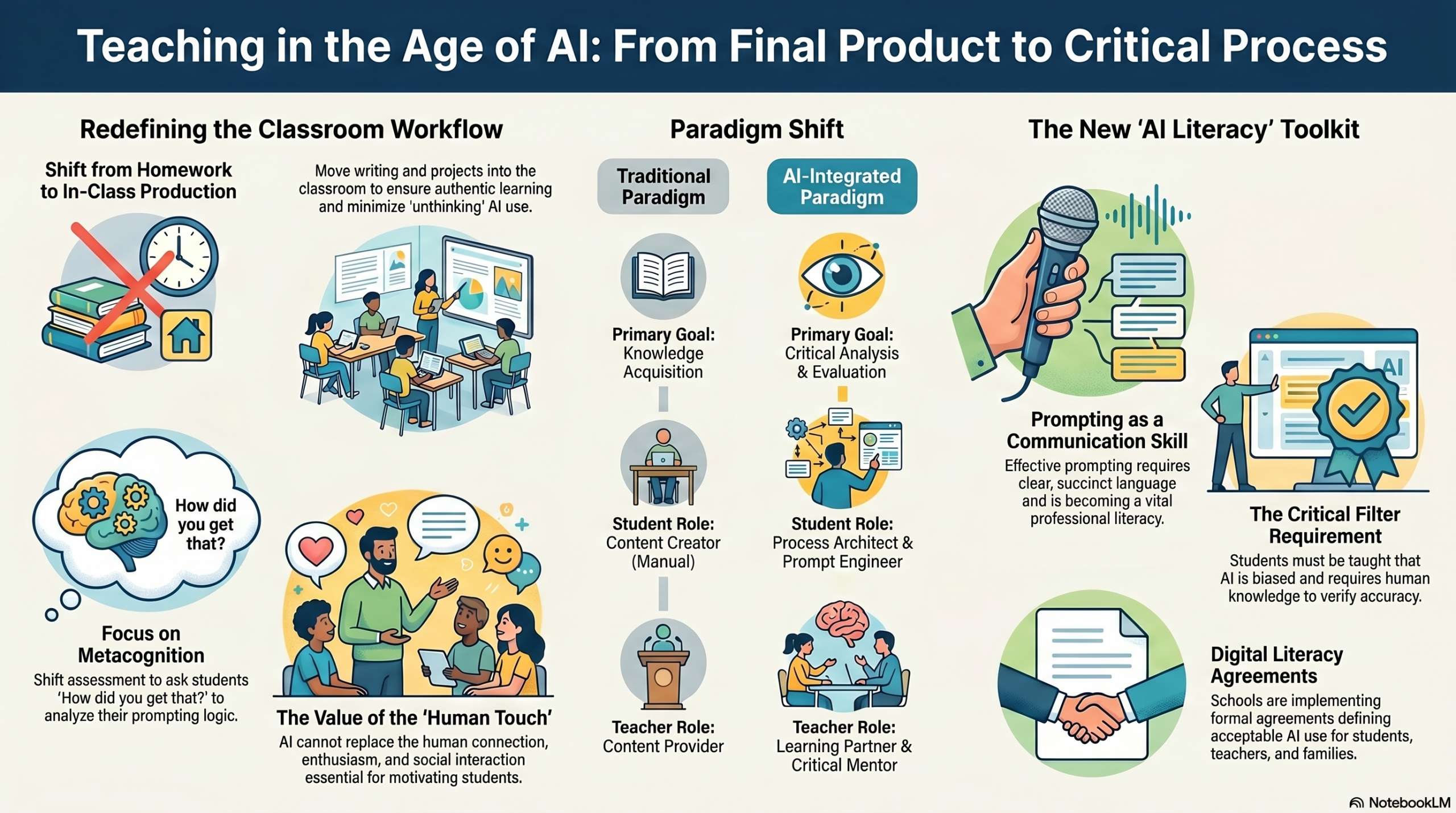
Learning remains human in the age of AI
A synthesis of what educators discussed about AI literacy, school impact, assessment, creativity, critical thinking, and the post-AI learning paradigm.
What can we do to provide AI alphabetization?
What is the short- and long-term impact on our school?
How can we prepare students for the post-AI learning paradigm?
Core insights
The conversation was not about rejecting AI. It was about integrating it responsibly while protecting learning, judgment, creativity, and the role of the teacher.
AI literacy needs a shared definition
Educators are unsure whether AI alphabetization can be taught like traditional literacy. It must include tools, ethics, bias, verification, prompting, privacy, and judgment.
Teachers need time to learn first
The group recognized that students often experiment faster than teachers. Professional development should focus on practice, classroom cases, and responsible guidance.
Homework and assessment must change
Traditional take-home writing is under pressure. Schools need more process evidence, in-class work, oral defense, prompt logs, and metacognitive reflection.
Critical thinking becomes more important
AI does not make knowledge unnecessary. Students need knowledge in order to judge whether AI outputs are accurate, biased, incomplete, or misleading.
Foundational skills still matter
The group worried that students may skip essential cognitive processes if AI does too much too early. Younger learners especially need language, play, social interaction, and thinking routines.
Prompting is a new communication skill
The discussion framed prompting as much more than a technical trick. A good prompt requires clarity, purpose, precision, language, and the ability to describe what one wants.
The human role remains central
Educators emphasized that AI can produce content, feedback, and practice, but cannot replace enthusiasm, relationships, social interaction, modeling, care, and classroom culture.
What changes for school practice?
The emerging strategy is not “AI everywhere” or “AI nowhere.” It is purposeful, age-appropriate, human-centered use.
Creativity is being redefined
AI shifts creativity from manual execution alone to idea generation, cultural relevance, prompt quality, iteration, selection, and explanation of choices.
AI can support differentiation
Teachers see strong value in adapting materials, creating rubrics, supporting language practice, generating examples, and helping students with different needs.
Balance is better than prohibition
The group sees AI as part of life. The challenge is to avoid panic, avoid blind adoption, and define where AI adds educational value.
Schools need shared agreements
AI cannot be managed only by individual teachers. Schools need clear agreements for students, teachers, and families so that expectations are transparent and consistent.
Recommended roadmap
A practical sequence for moving from concern and experimentation toward coherent school-wide practice.
Define AI literacy for the school community
Include practical, critical, ethical, creative, and metacognitive dimensions.
Train teachers through classroom scenarios
Move beyond tool demonstrations into assessment redesign, verification, and subject-specific uses.
Redesign homework and assessment
Use process evidence, in-class checkpoints, oral explanation, and prompt reflection.
Create student, teacher, and family agreements
Clarify acceptable use, disclosure, privacy, risks, and responsibility.
Build an age-sensitive progression
Protect early cognitive development while gradually introducing AI judgment and responsible use.